The Neolithic is a remarkable period during which cardinal changes occurred in the way of life of human communities, which left a strong imprint on the entire history of humankind. Socially and economically, it marks the moment when people began to cultivate cereals and legumes (spelt, durum wheat, barley, lentils, and peas) and raise domestic animals (goats, sheep, cattle, and pigs). These activities require primarily a sedentary lifestyle, which accordingly stimulates the construction of houses and settlements.
These changes first took hold in Western Asia in the region of Northern Syria, South-eastern Turkey, Northern Iraq, and Iran sometime around 11-10,000 BC and from there they gradually spread in all directions. This way of life reached South-east Europe about the middle of the 7th millennium BC (6700-6500 BC), and in the region reviewed here – a little later. The earliest settlement in the valley of the Middle Struma appeared near the village of Kovachevo around 6200 BC. More settlements were built across the Struma catchment basin after the end of the 7th millennium BC and at the beginning of the 6th millennium BC, showing that the establishment of the productive economic model is a complex, multidirectional, and lengthy process.
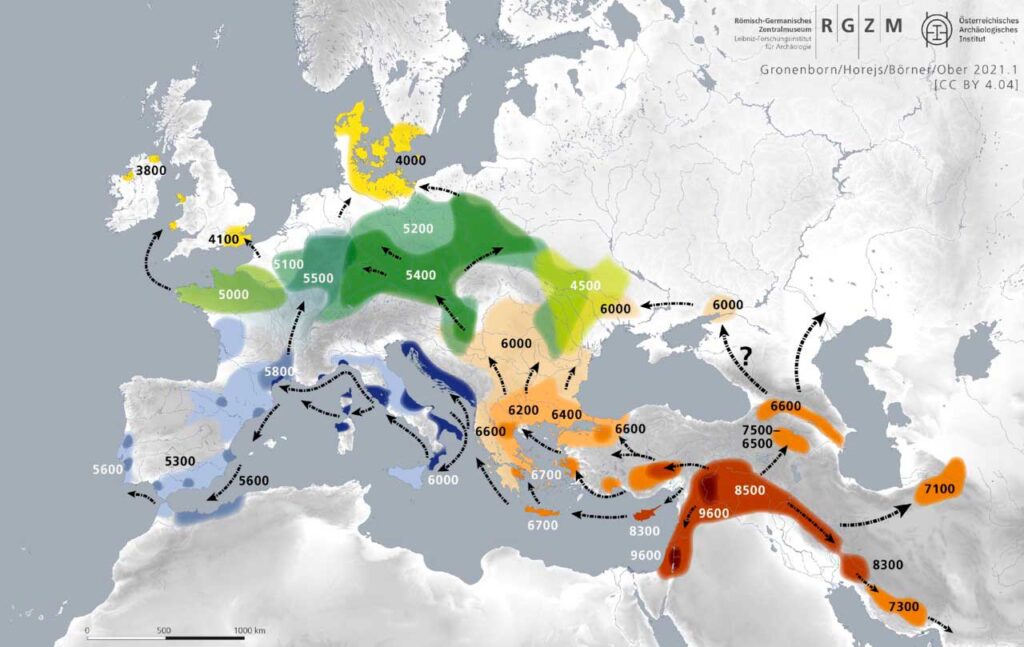
The entire 6th millennium BC (the Neolithic period) is marked by the improvement of the economy and its accompanying activities like the construction of permanent dwellings, the production of ceramic vessels, an increase in the size of the settlements – and undoubtedly of cultivated areas, as well as the amount and types of livestock raised. The range and proportions of the various cultivated species also changed over the period. If at the beginning of the Neolithic (Early Neolithic) sheep and goats dominated the faunal assemblages, then in the second half of the 6th millennium BC (Late Neolithic) the focus shifted towards cattle husbandry, implying not only the provision of larger pastures and dry food (hay) for the winter, but also more numerous communities to benefit from the increasing amount of animal products. It is no coincidence that this period saw the establishment of larger settlements, such as Topolnitsa and Damianitsa – the latter being one of the largest in Bulgaria, with an area of about 21 hectares. Not only their size increased, but there is marked structural development such as specially designated areas of an economic nature for surplus products (grain silos, fenced areas for animals) and for specific activities (ceramic workshops, flint tool workshops) and developed cult/spiritual practices.

The second half of the 6th millennium BC is characterized by the appearance and spread of Vinča culture across South-eastern Europe. It has a markedly agrarian character and quite a few regional variants. The southern part of the Balkan Peninsula developed in a separate way. It was always dominated by cultures characterized by exquisitely painted ceramics, a feature-characteristic of Eastern Mediterranean cultures. These two great cultural traditions: the Vinča culture from the north-west and the Akropotamos-Topolnitsa culture from the south meet precisely in the Struma Valley at the end of the 6th millennium BC. Was there a physical clash and struggle for supremacy between them or a fruitful coexistence and exchange? Some of the answers to this question will be provided by the study of the Late Neolithic settlements in the region, one of which is Drenkovo I.
